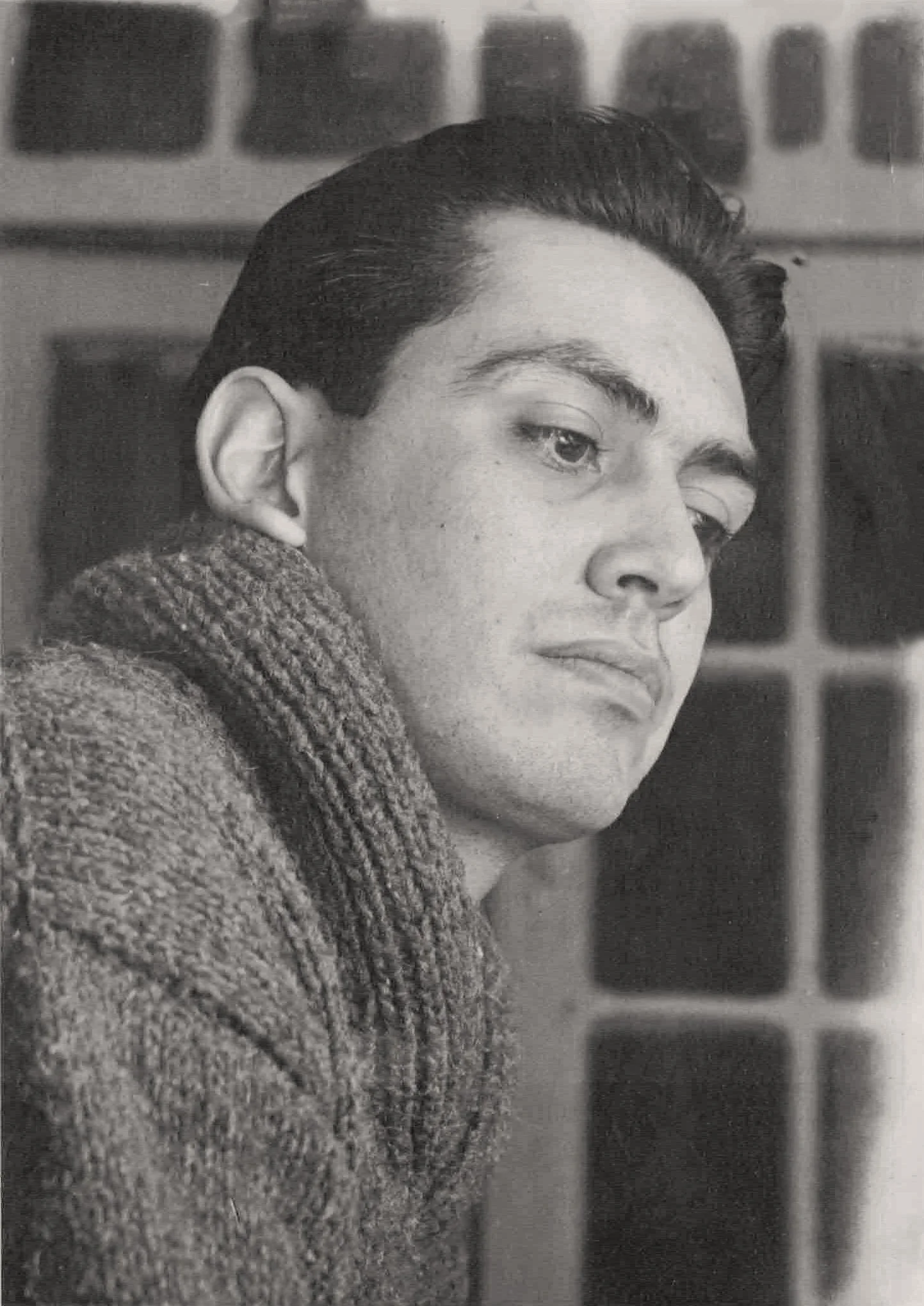
Sergio O’Cadiz Moctezuma, 1950s
O’Cadiz Family Collection
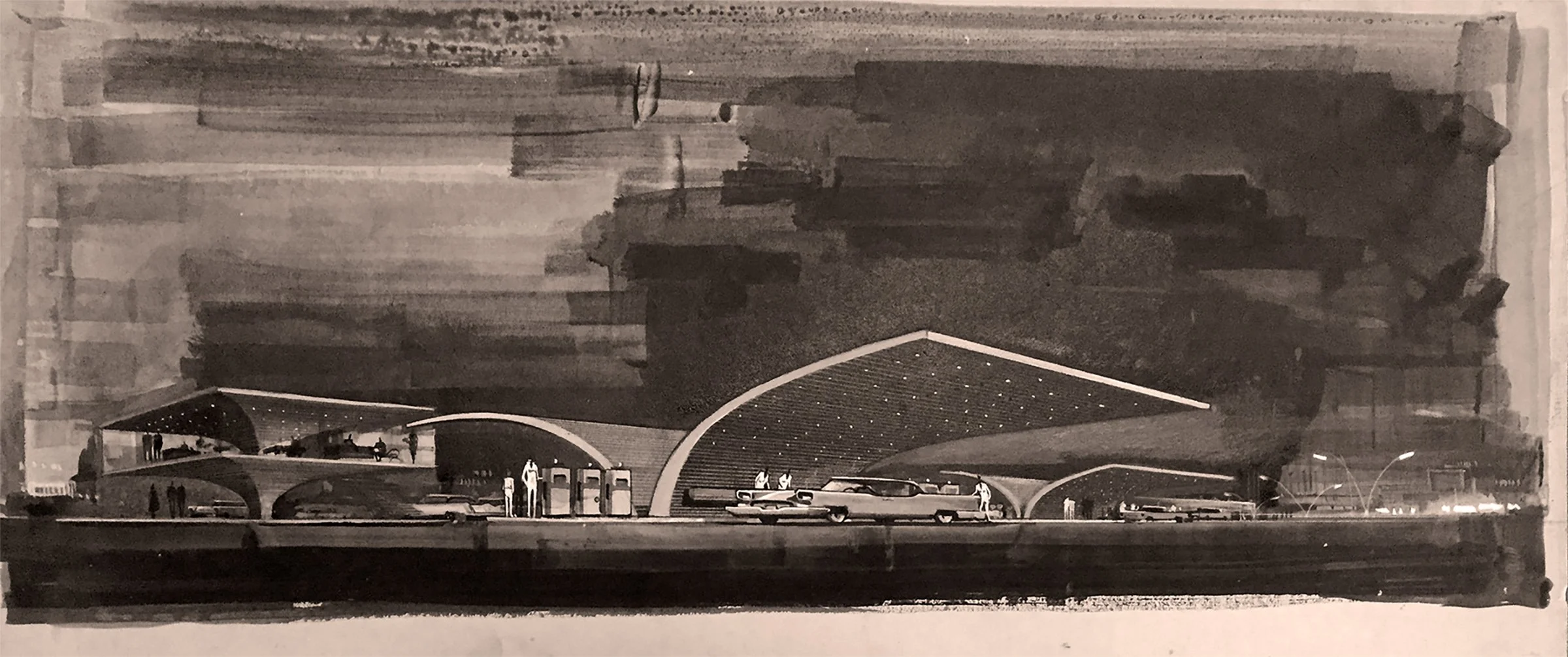
Sergio O’Cadiz Moctezuma, Architectural Rendering of a Garage (1960s)
O’Cadiz Family Collection
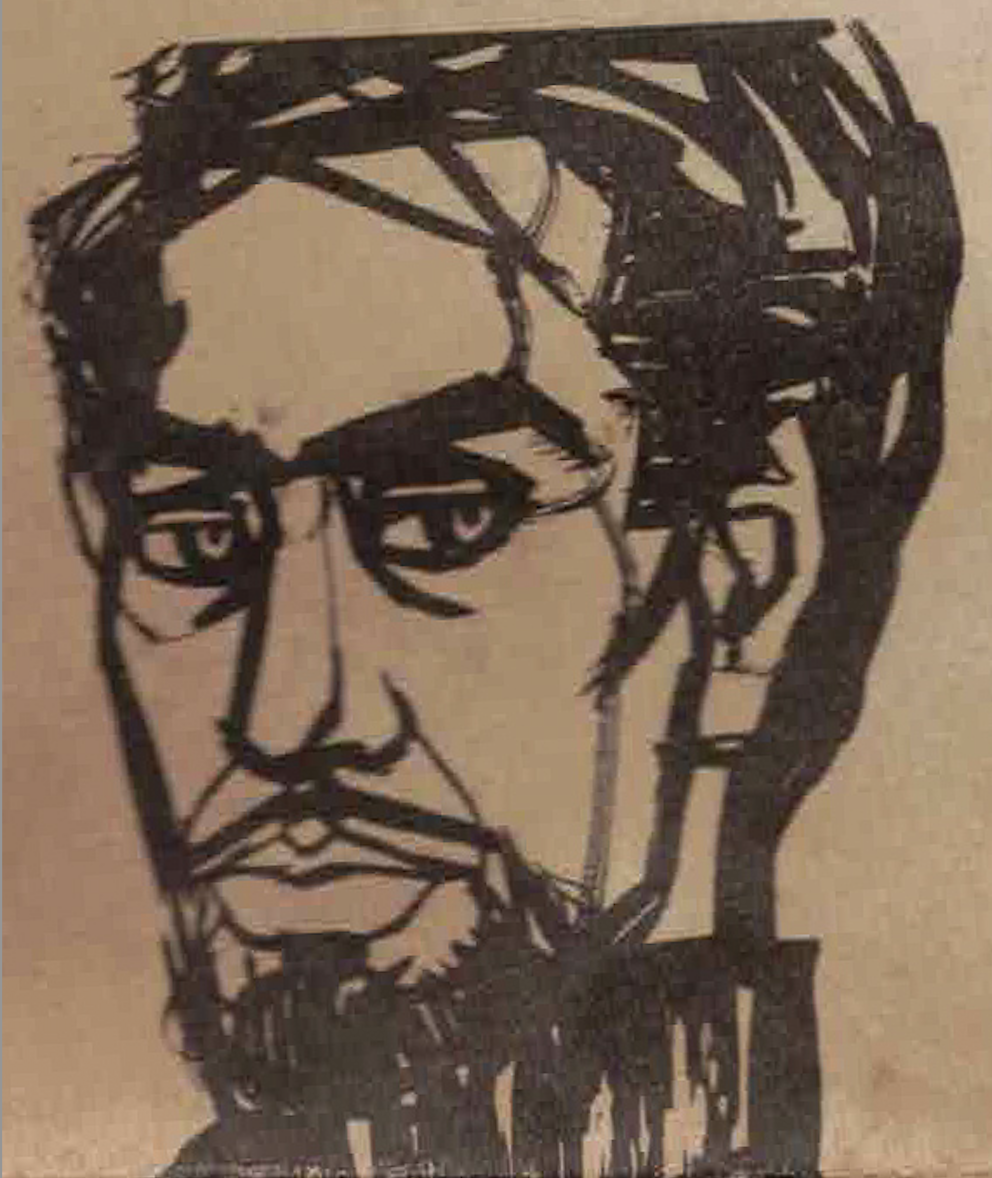
Sergio O’Cadiz Moctezuma, Self Portrait, ink on paper (c. 1966)
O’Cadiz Family Collection
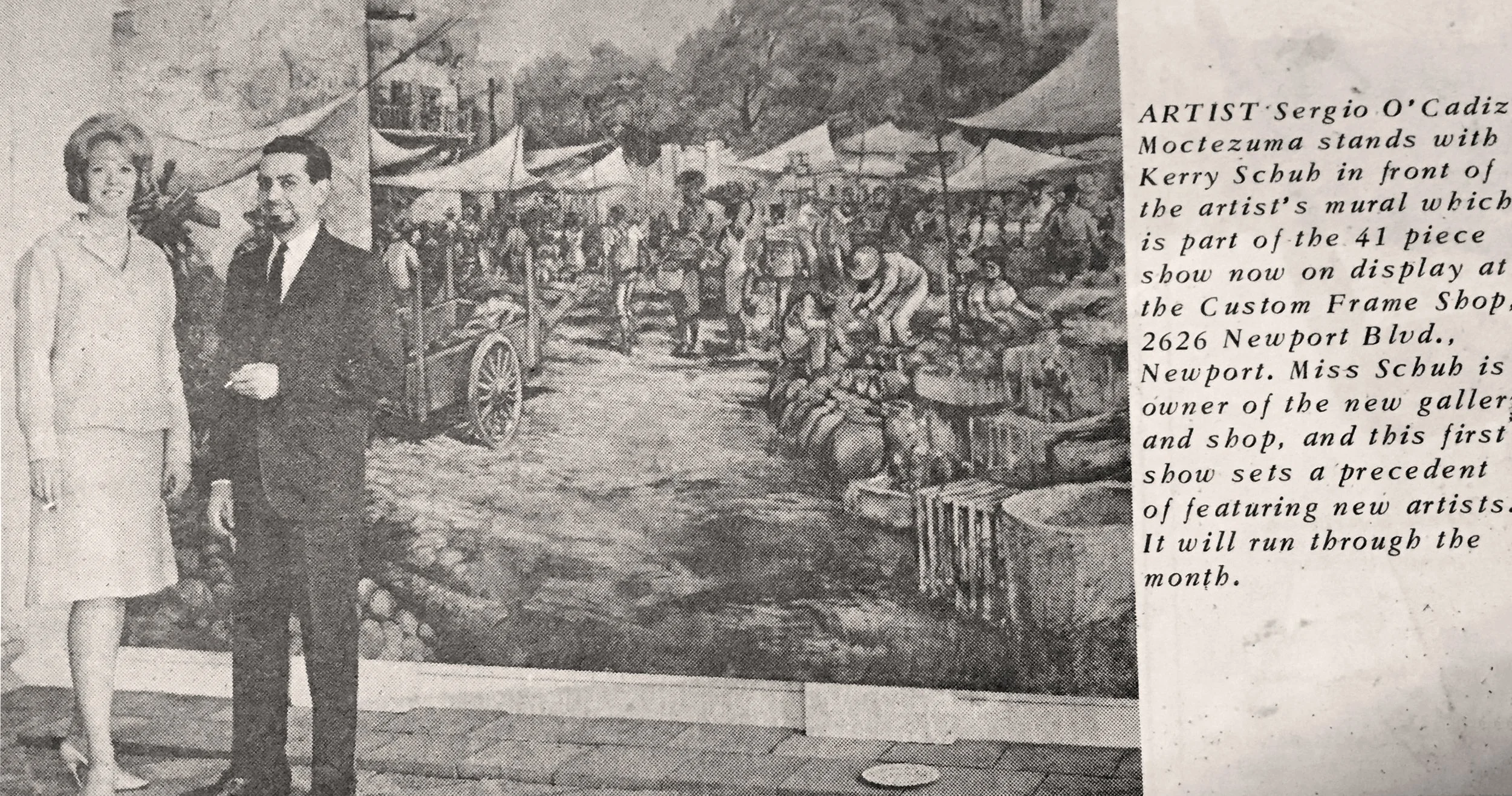
Article about Sergio’s exhibition at the Schuh Gallery, 1966.
O’Cadiz Family Collection
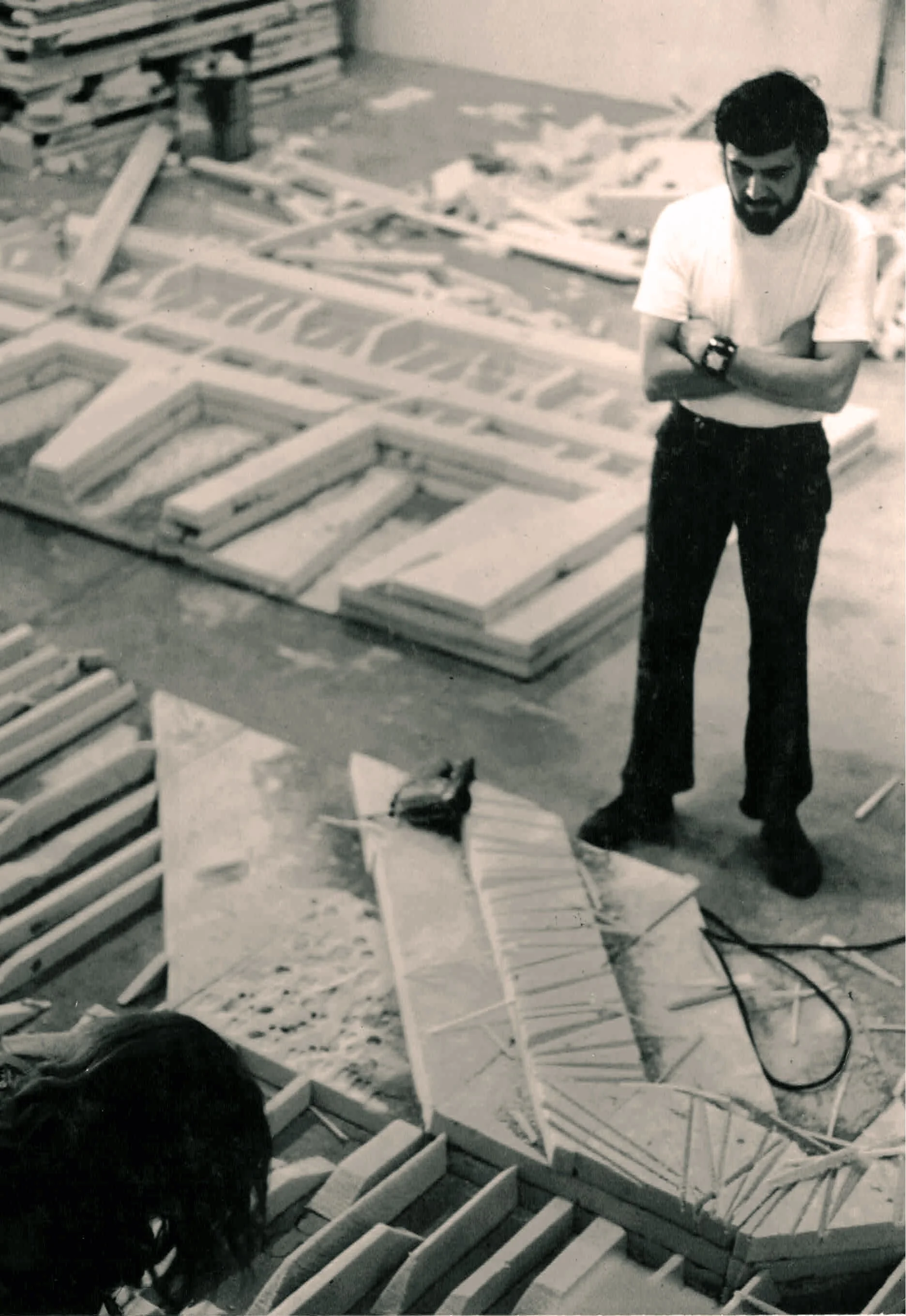
Sergio carving Styrofoam forms in his studio for a concrete relief, 1967.
O’Cadiz Family Collection
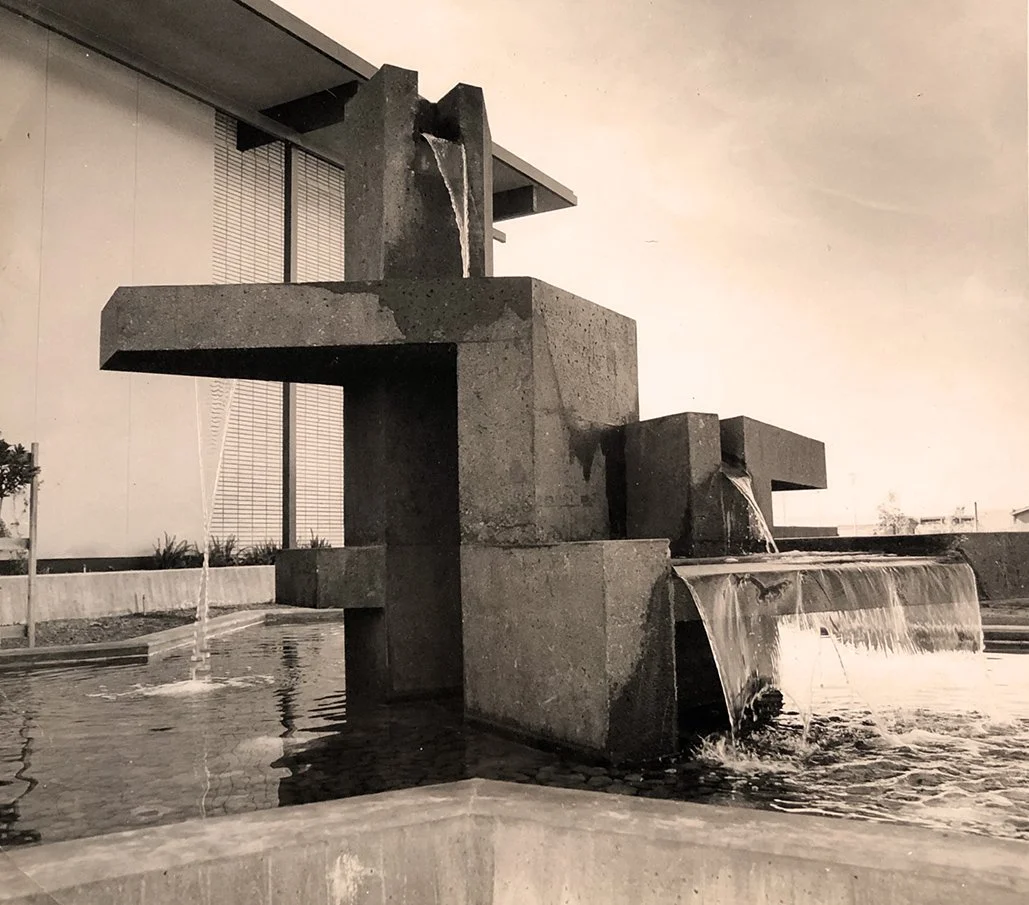
Fountain Valley Fountain, concrete (1969)
O’Cadiz Family Collection
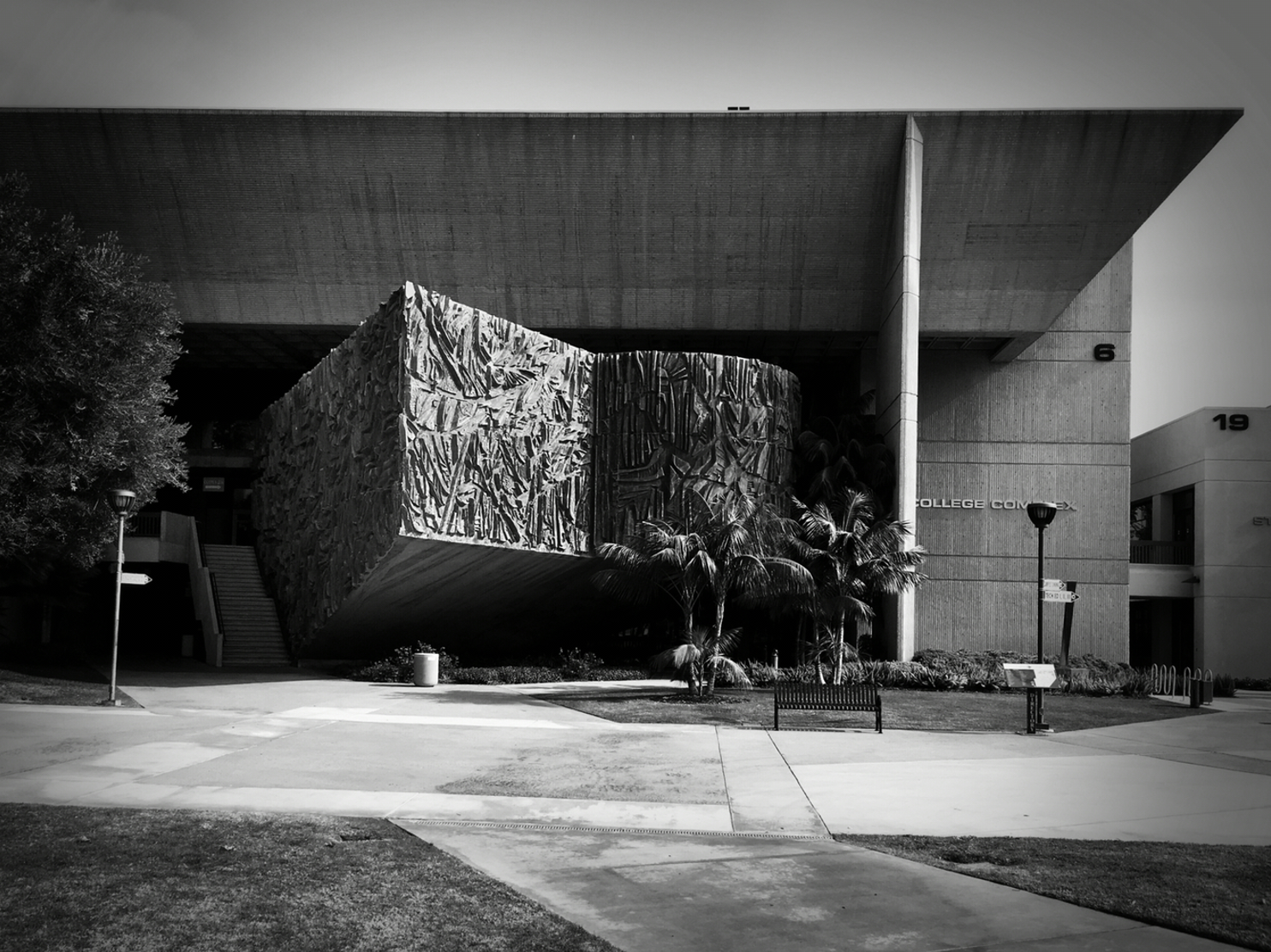
Cypress College Library Mural. Photograph by Julius Shulman in 1970. © J. Paul Getty Trust. Getty Research Institute, Los Angeles (2004.R.10)
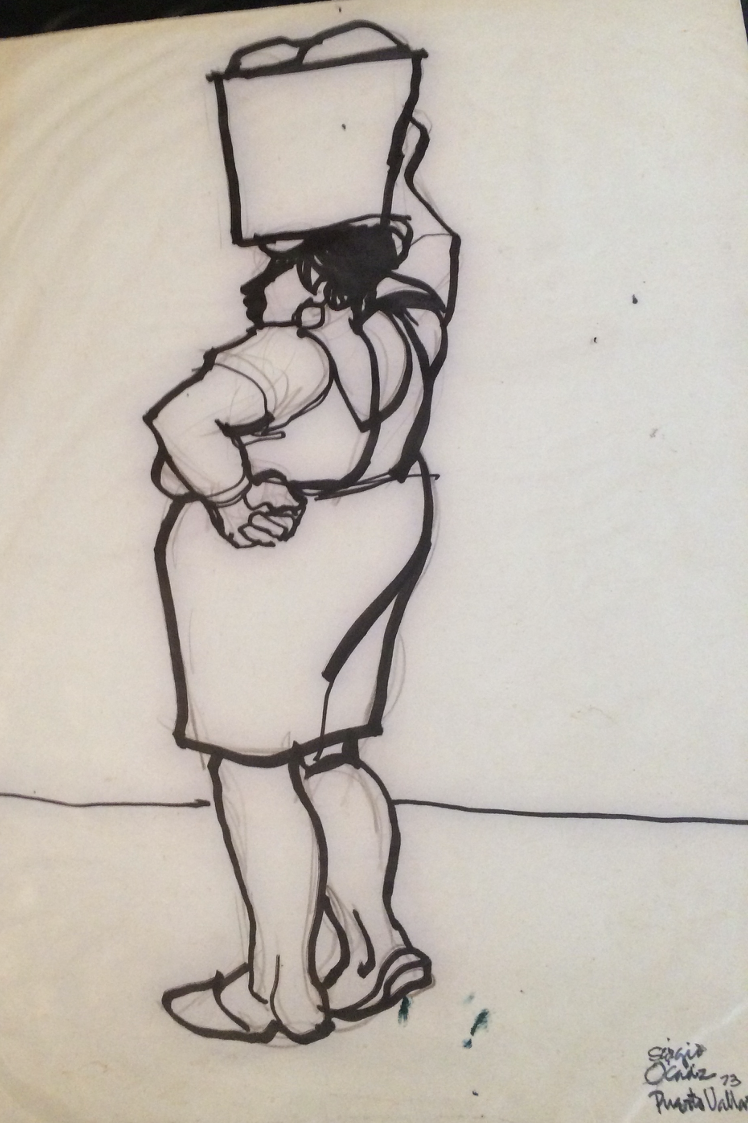
Sergio O’Cadiz Moctezuma, Puerto Vallarta, pencil and ink on paper, 1973.
O’Cadiz Family Collection
A section of the Colonia Juarez Community Mural, (1974-1976). White paint is seen defacing a scene of police dragging a youth into a car.
O’Cadiz Family Collection
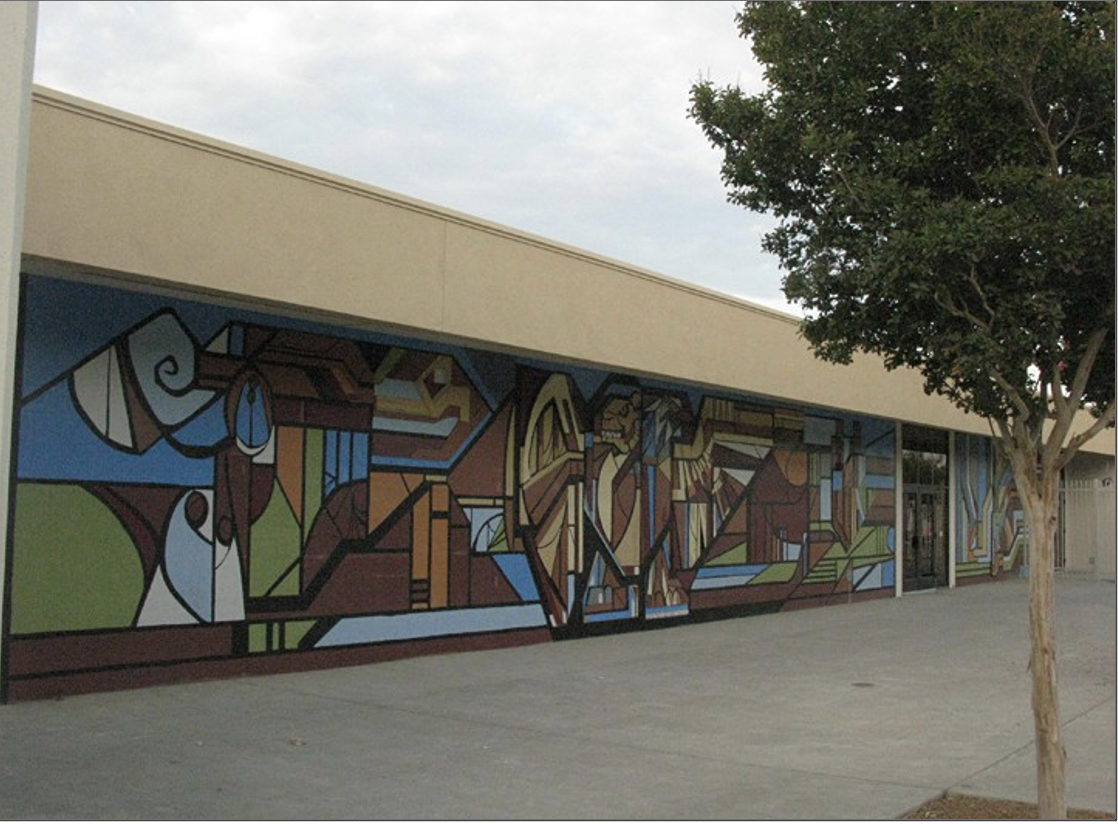
Monroe Elementary School mural, Santa Ana, 1973
O’Cadiz Family Collection
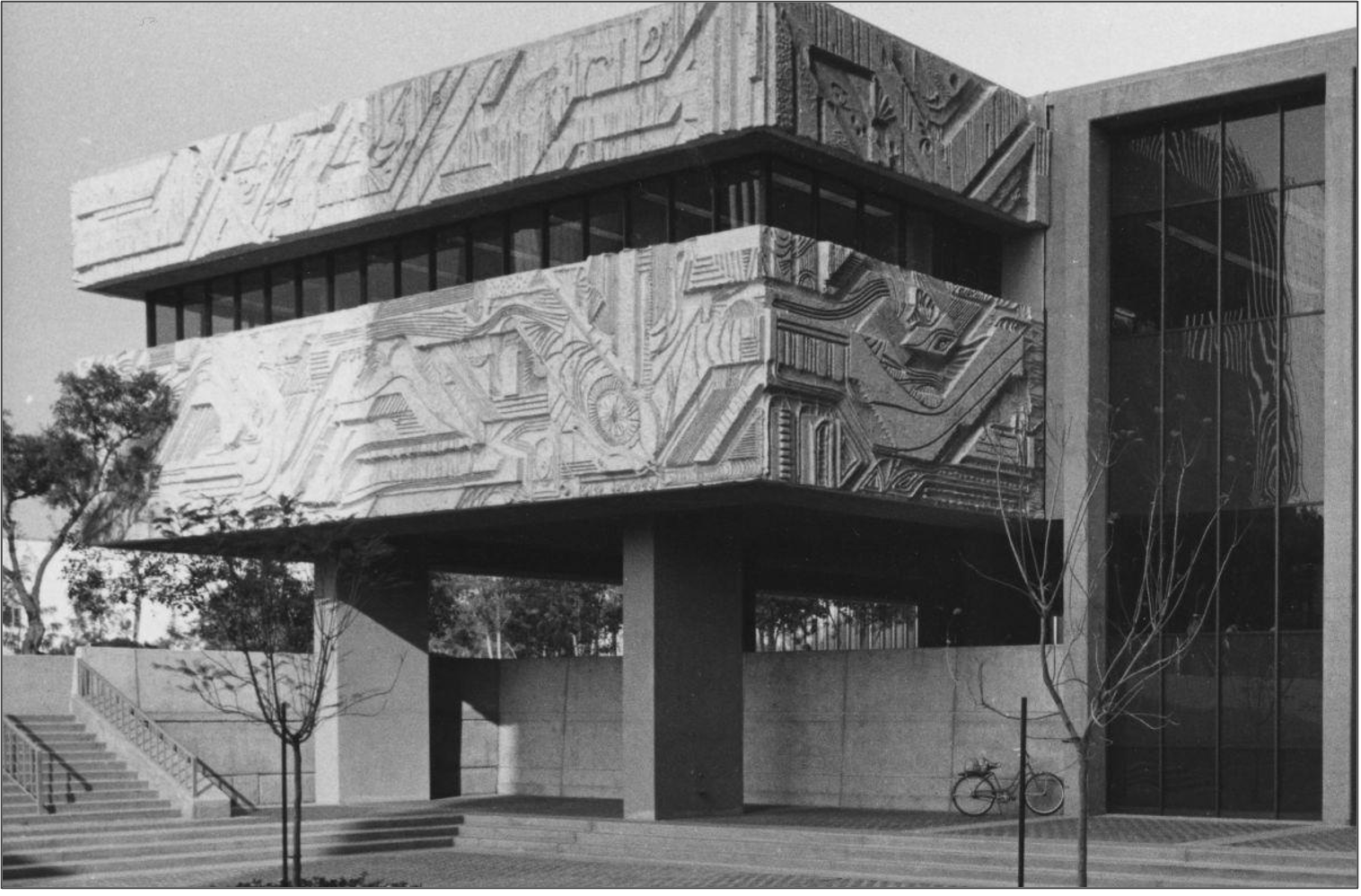
Santa Ana City Hall mural, 1972-1973. Partially destroyed, 2000.
O’Cadiz Family Collection
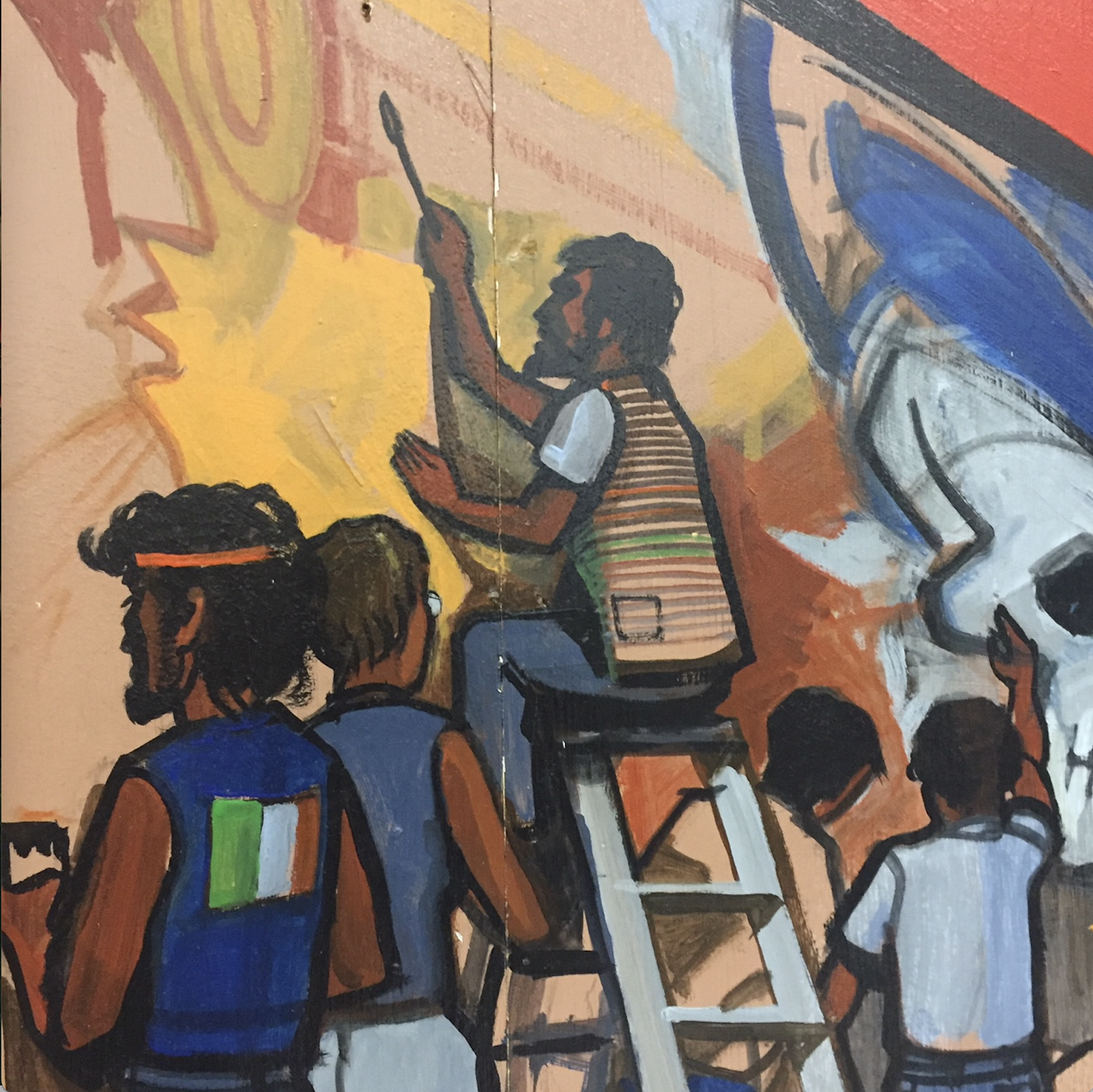
History and Evolution of the Chicano in the United States (8 x 80-ft). (1974)
Known as the MECHA Mural. The final scene shows Sergio and students working on the piece.
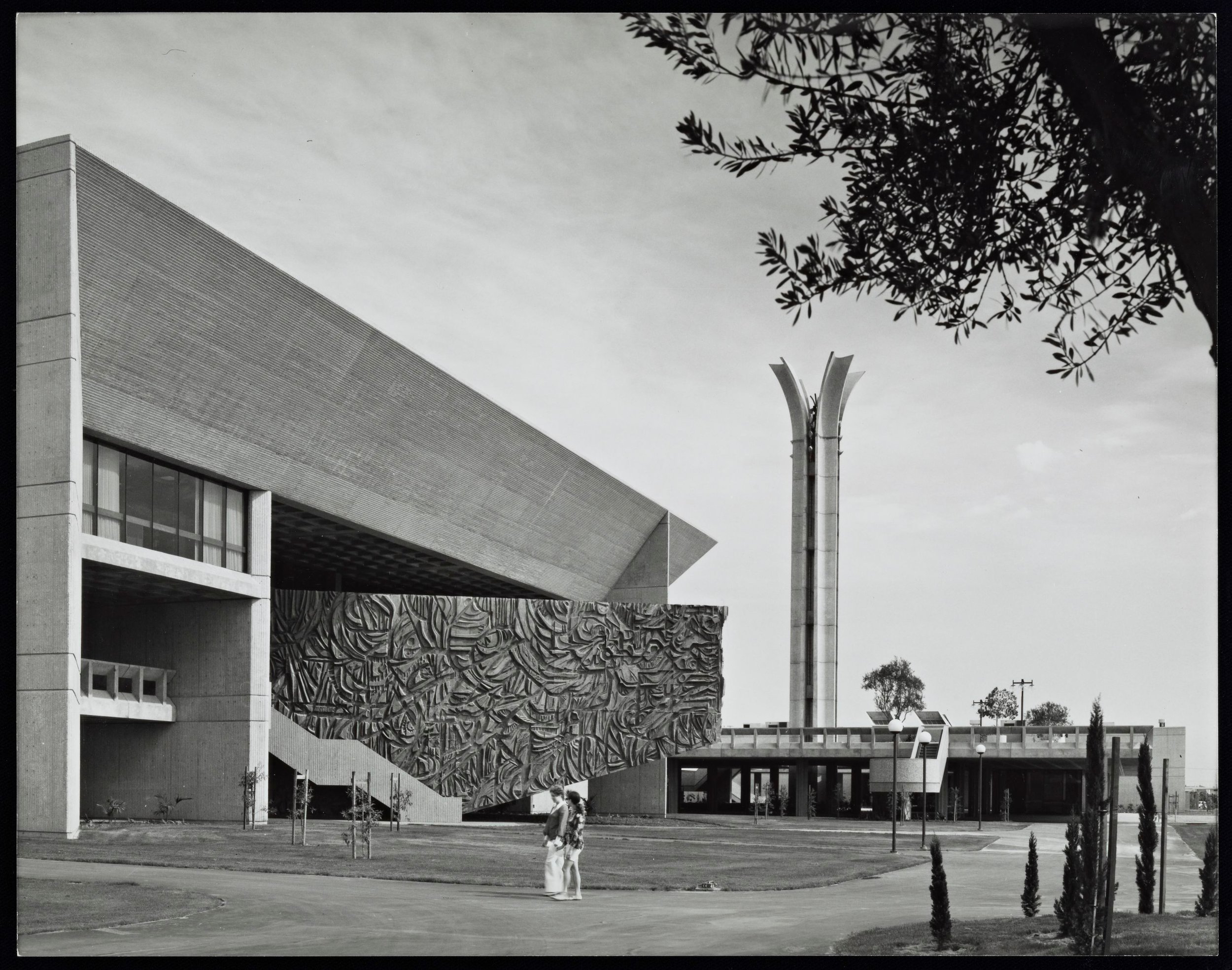
The Cypress College Library Mural, an expressive counterpoint to its paler, grid-based surroundings. Photographed by Julius Shulman in 1970. © J. Paul Getty Trust. Getty Research Institute, Los Angeles (2004.R.10)

A detail from Colonia Juarez Community Mural, 1974
O’Cadiz Family Collection
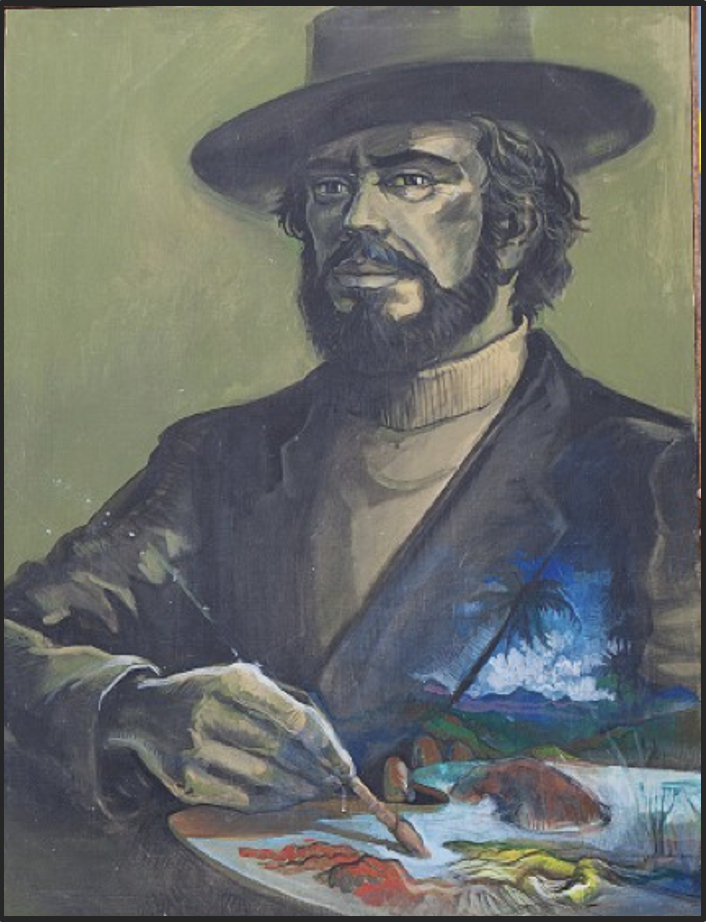
Sergio O’Cadiz Moctezuma, Self-Portrait,
(c. 1975)
O’Cadiz Family Collection
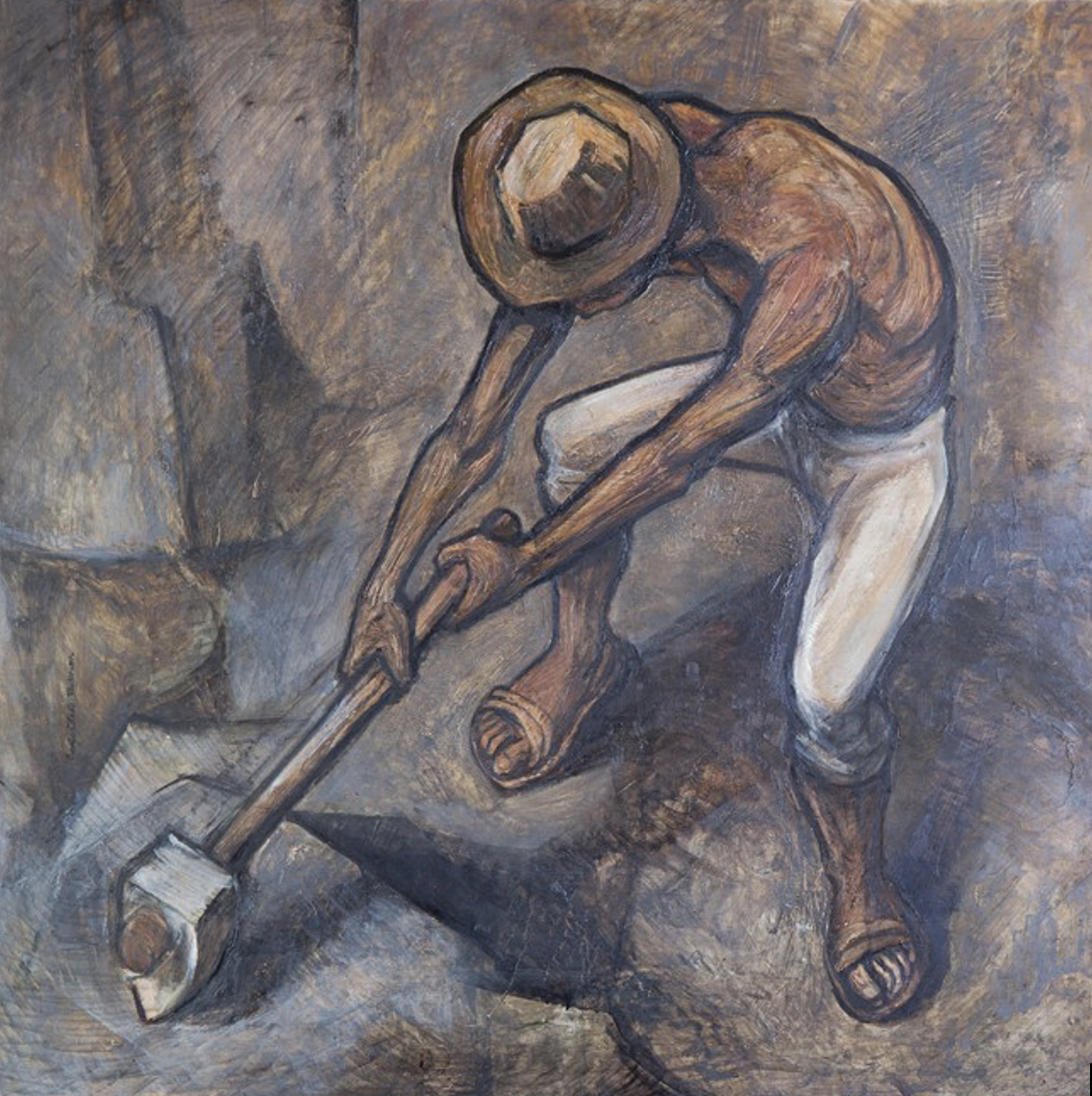
Sergio O’Cadiz Moctezuma, Stone Breaker,
c. 1975
O’Cadiz Family Collection
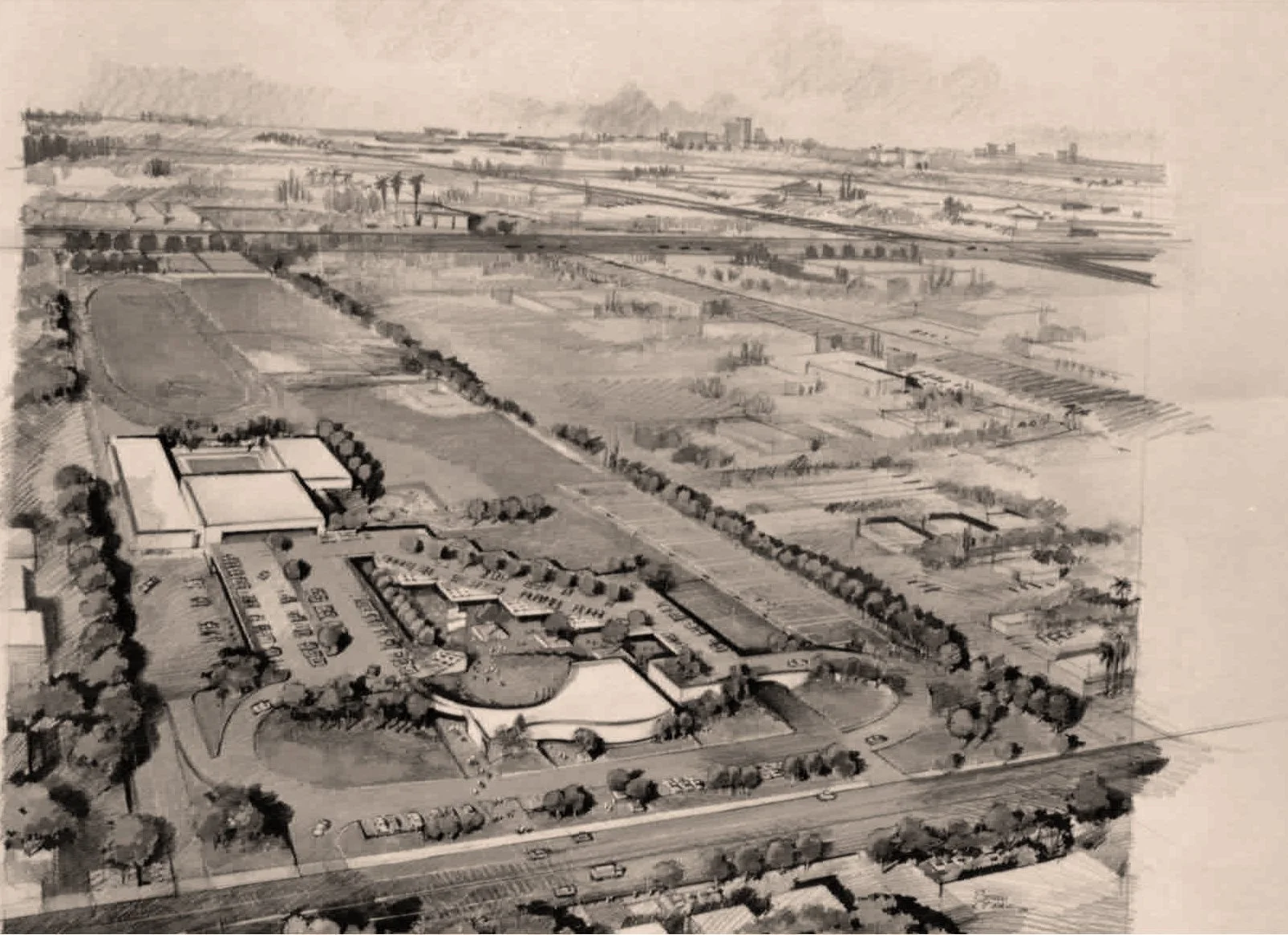
Sergio O’Cadiz Moctezuma, Architectural Rendering, 1980s.
O’Cadiz Family Collection
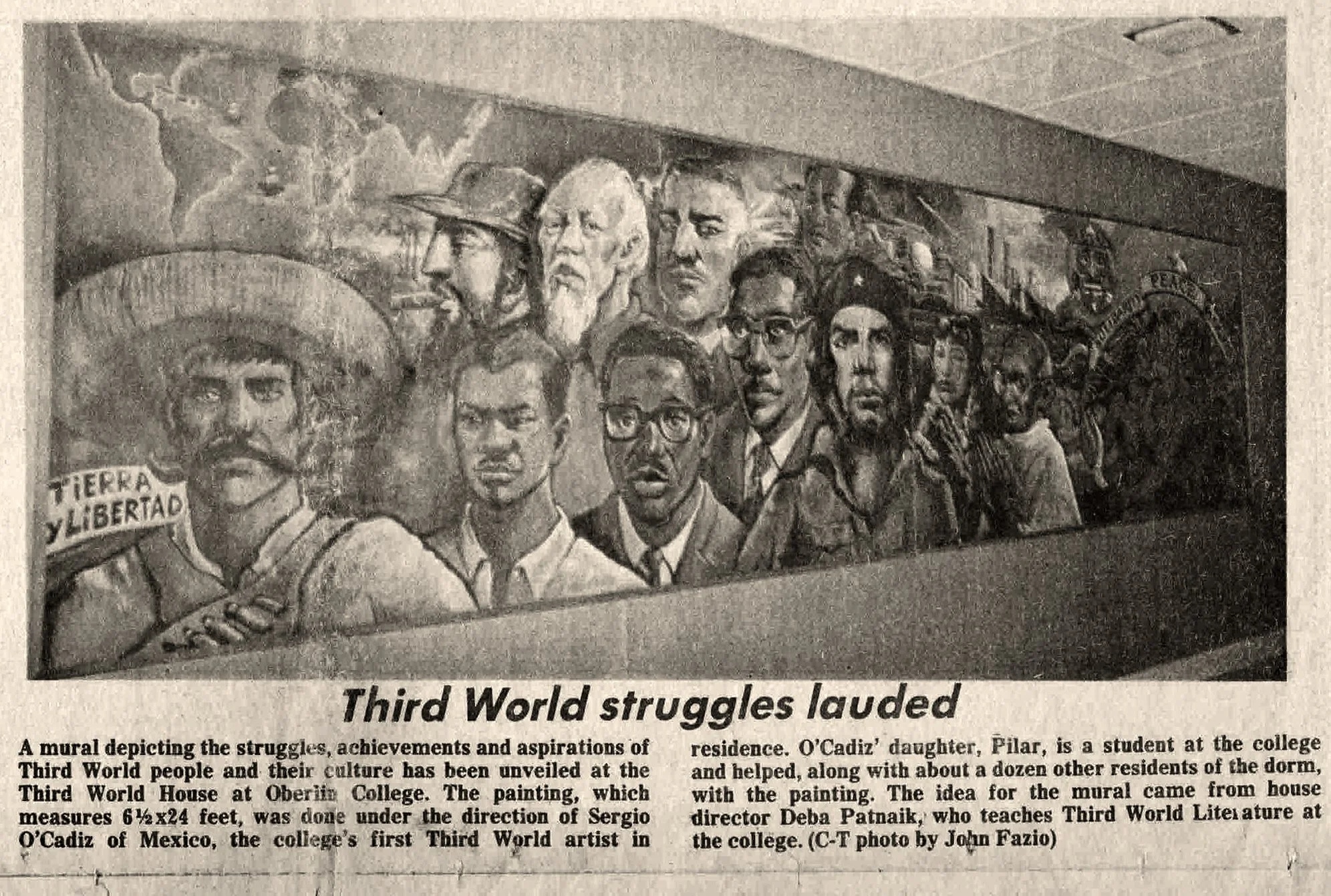
Article about O’Cadiz Moctezuma’s Oberlin College mural (1984)
O’Cadiz Family Collection
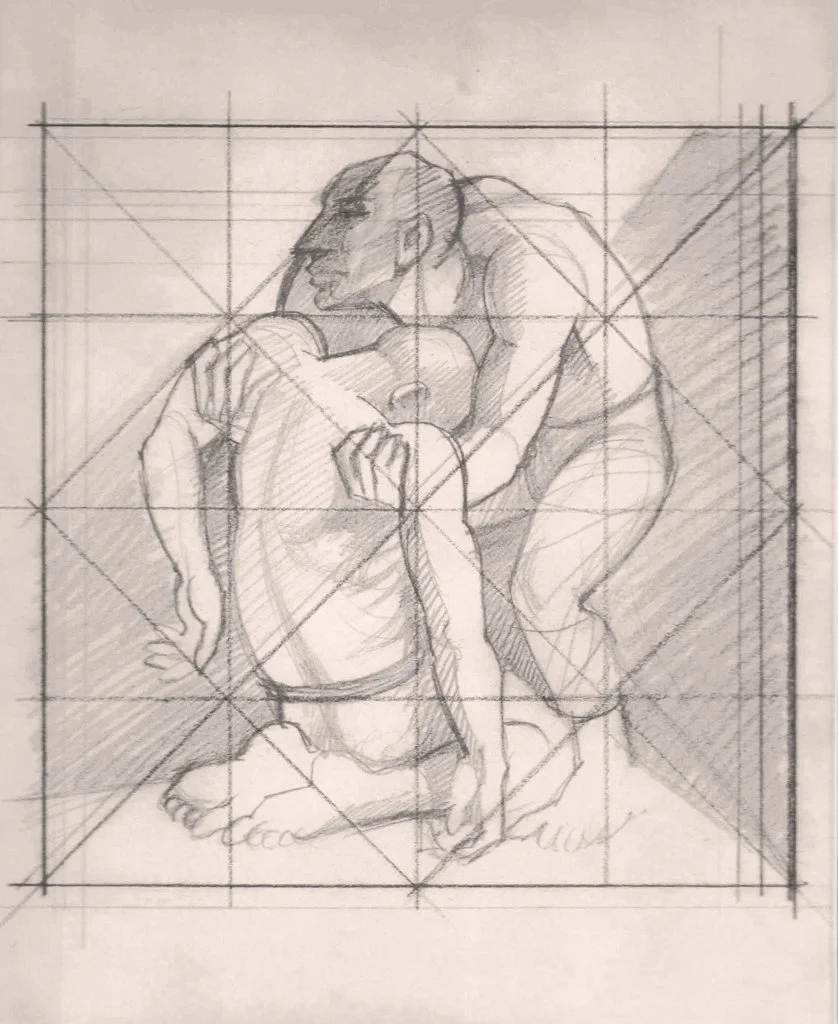
Sergio O’Cadiz Moctezuma, Drawing for Honduras, pencil on paper (1998)
O’Cadiz Family Collection
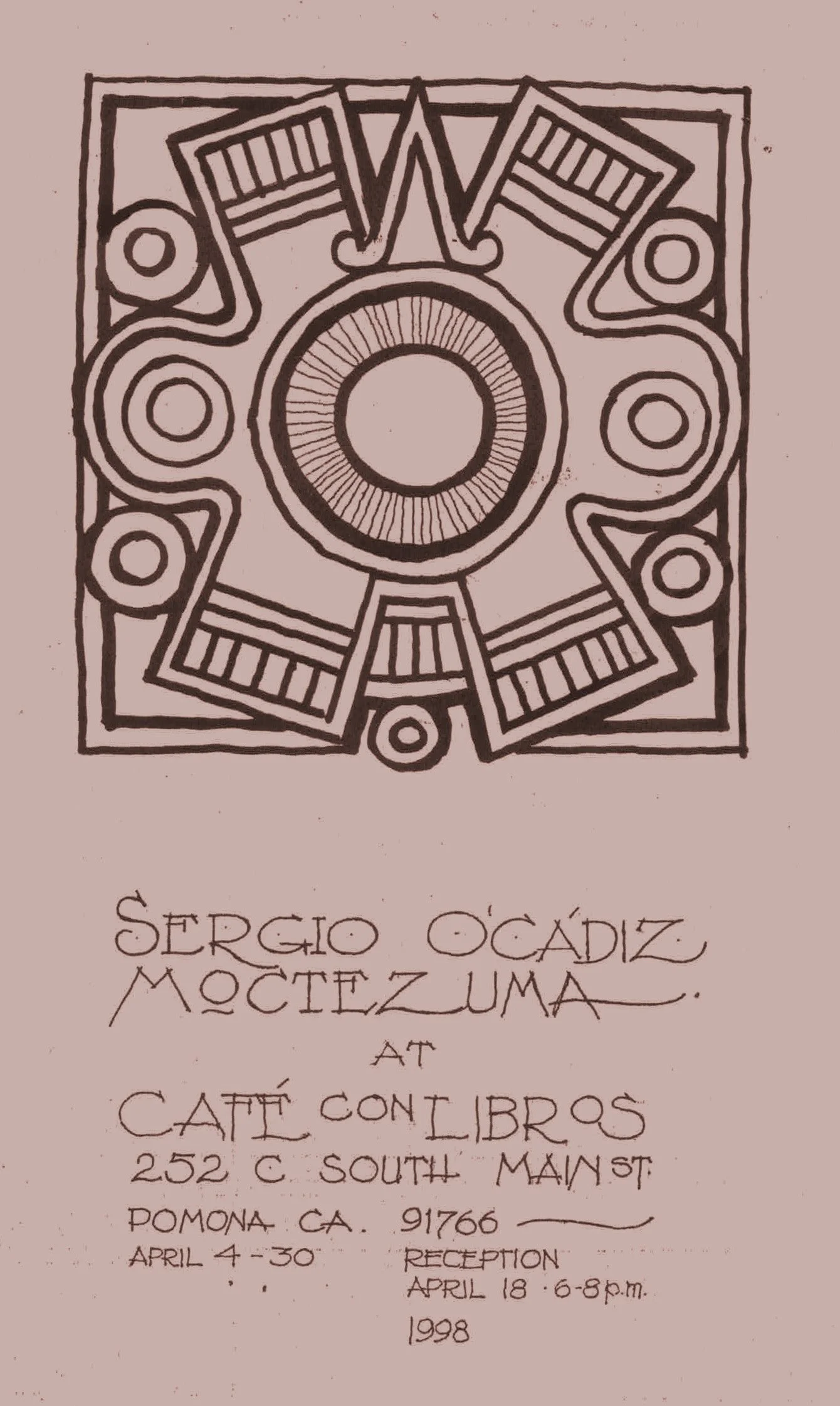
Invitation for Sergio’s exhibition at Café con Libros, Pomona, CA.
O’Cadiz Family Collection
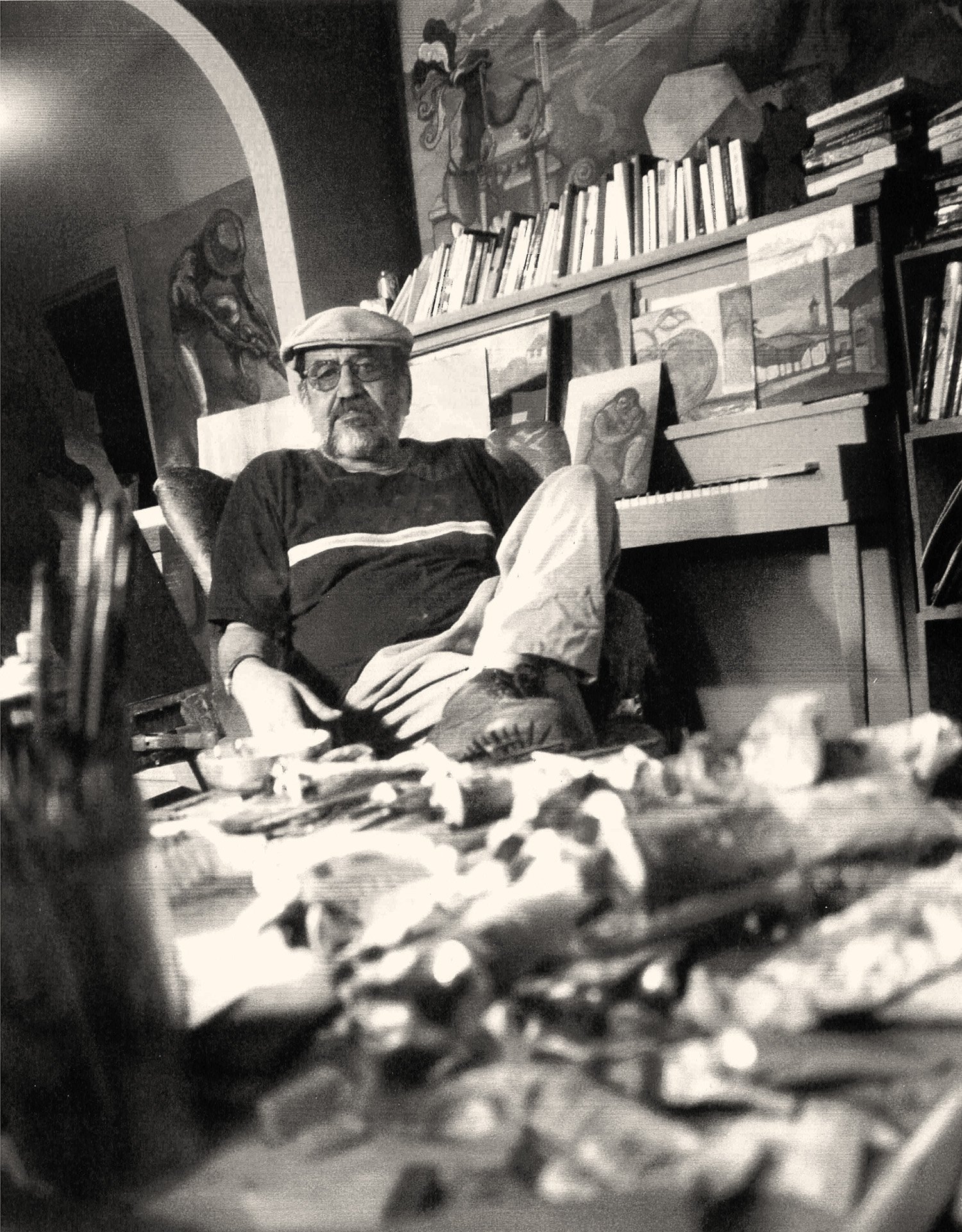
Sergio O’Cadiz Moctezuma in his studio (c. 2001)
O’Cadiz Family Collection
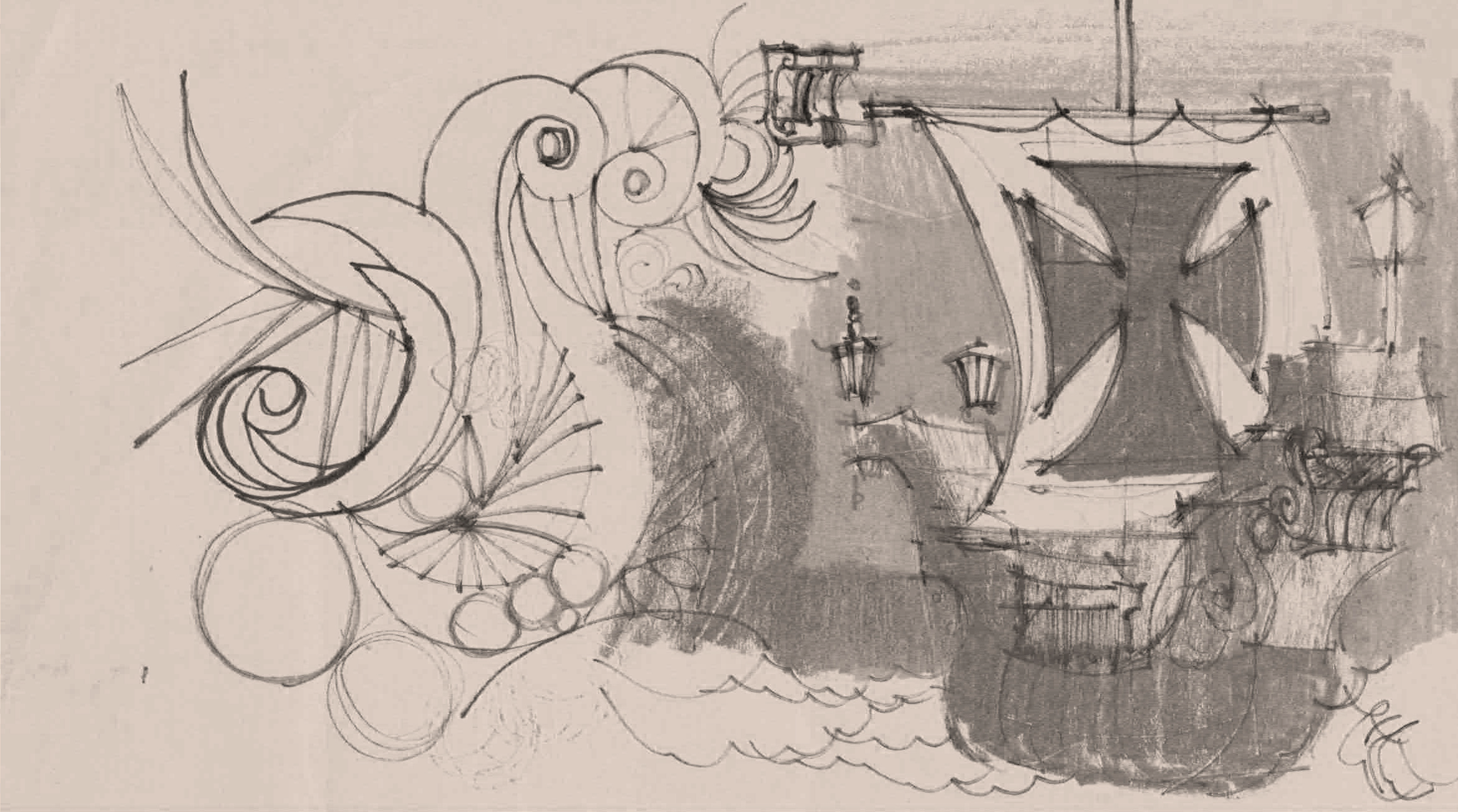
Sergio O’Cadiz Moctezuma, Sketch of a Galleon. Date unknown.
O’Cadiz Family Collection
J. Sergio O’Cadiz Moctezuma
Timeline
1934–1961
Domitila de la Paz Moctezuma Jara gives birth to Julio Sergio O’Cadiz Moctezuma on November 10, 1934. The baby’s mother met his father, public accountant Julio O’Cadiz Ortiz, while working as a secretary at Mexico’s Ministry of Finance. The family live in Barrio Mixcoac, Mexico City.
Young Sergio’s artistry blossoms from an early age. Educated initially at a Jesuit-run school in Mexico City, he goes on to study at the Escuela Nacional de Pintura, Escultura y Grabado—La Esmeralda – where he takes master classes with Diego Rivera; the prestigious Academy of San Carlos; the Independent School of Painting and Sculpture; and the National Autonomous University of Mexico (UNAM). While still a student, O’Cadiz Moctezuma exhibits his work at a variety of Mexico City venues.
Having ended his studies in architecture in 1958, O’Cadiz Moctezuma embarks on a professional career that sees him teach art, exhibit his work, and design for a park and various private residencies while also working with well-established architects. Most notably, Federico Ernesto Mariscal Piña, and Pedro Ramírez Vázquez, “who led many of Mexico’s landmark Modernist construction projects of the mid-20th century,” including the monumental, Brutalist National Museum of Anthropology, on which O’Cadiz Moctezuma worked. The pattern of operating in multiple disciplines and arenas that will characterize Sergio’s future practice is already in place.
1934 Born in Mexico City
1953 Exhibits work at the Mexican Society of Architects, Mexico City
1954 Exhibits work at Galerias Misrachi, Mexico City, Mexico
1955 Exhibits work at Galeria Glantz, Mexico City, Mexico
1956 Marries María Covadonga O’Cadiz González Verdu in Mexico City
1956 Exhibits work at Galeria Excelsior, Mexico City, Mexico
1957 Becomes a father when eldest child, Susana, is born in Mexico City
1959 Exhibits at El Jardin Del Arte
1959-1961 Creates designs for public park Ciudad Deportiva
Works for Pedro Ramírez Vázquez on buildings that include the National Museum of
Anthropology
1962–1966
Having moved from Mexico City to California, O’Cadiz Moctezuma begins work for William E. Blurock & Associates, a pioneer in designing Brutalist educational buildings, while also exhibiting his art works at local venues.
As a member of the Blurock team, O’Cadiz Moctezuma is encouraged to find ways to include artworks in buildings that range from recreational facilities, campuses, and churches, to restaurants, civic centers, and office blocks. Initially, the artist thrives in a company that encourages his boundary-crossing practice. However, seeking more creative input into his work, and greater self-determination, he leaves Blurock in 1967.
“I went through a terrible culture shock when I came here…what used to be my values were suddenly invalidated. I had a good education, good manners, they meant nothing. Here you’re just supposed to work. Work is the goal and how much money you make is the reward…I had come from a country with 4,000 years of architectural background and here I found no intellectual orientation. People were concerned with the business of building buildings rather than the meaning the buildings had within society as a whole.”
1962 Moves to USA
Becomes a father for the second time when Maria del Pilar is born
Completes conceptual drawings for the new Blurock–designed Orange Coast College (OCC)
Science Hall. One is presented to OCC
President Basil Peterson, who writes to Sergio complimenting him on “a fine piece of art”
1964 Designs murals for departmental identification at Estancia High School, Costa Mesa
Sergio and María’s third daughter, Ana Maria, is born
1966 Exhibits work in a one-person show at the Kerry Schuh Gallery
Sergio and María’s first son, Sergio Arturo, is born. With psychological pressures mounting up,
the artist is briefly hospitalized.
1967–1969
After his amicable exit from Blurock, O’Cadiz Moctezuma begins to explore the freelance possibilities available to a Mexican artist and architectural designer in Orange County in the late 1960s. True to his expansive art practice, they are diverse. In addition to working as a design consultant for architectural companies, including Blurock, he continues to exhibit his paintings and drawings, and begins to make theater sets, which veteran Hollywood columnist Dick Kleiner describes as “brilliant” and “brooding.”
At this time, O’Cadiz Moctezuma also develops an innovative method of making large concrete walls that are both structural and sculptural. He first uses it on a grand scale on Cypress College campus, where he creates the 6,200 square foot Library Mural that still reaches out from the front of the College Complex building.
A multi-textured, red-ochre counterpoint to the grey fortress behind it, Library Mural expands the Brutalist repertoire used to build Cypress College in ways that challenge High Modern architectural theory. It also offends then-Cypress College President Daniel Walker, who describes it as: “the most beautiful definition of rust” which “promises to renovate the whole scrap iron business.”
“I didn’t make much money and I had to do a lot of (architectural) renderings to pay the debts for it,” O’Cadiz later says, “but I put my whole heart into it.”
1967 As set designer for the South Coast Reparatory Company, designs and executes sets for Red
Magic by Michel de Ghelderode, A Moon for the Misbegotten by Eugene
O'Neill, and Playboy of the Western World by J. M. Synge
Design, execution, and supervision of construction of Library Mural at Cypress College
Exhibits work at Corona del Mar library
1968 Directs installation and graphic design for the Balboa Pavilion Gallery’s exhibition Arts of the
Northwest Coast Indian and Alaskan Eskimo. (The Balboa Pavilion will later
become the Orange County Museum of Art)
Exhibits woodblock prints, oil paintings, drawings and sculpture in a one-person show at
Macaray Gallery, Anaheim C.A.
Becomes Architectural Design Consultant for Desmond Muirhead Inc., a firm specializing in
the design of golf courses and resorts worldwide, working on projects in
Spain and Japan. Continues in this role until 1972
1969 Designs, executes, and supervises construction for Sculptural Fountain for Fountain Valley
Civic Center (cast concrete, 15 x 15 x 20 ft.)
1970–1977
By the early 1970s, with his studio-based painting practice thriving, O’Cadiz Moctezuma is also in demand for major corporate and public projects. Although his public artworks tend to fall into two categories – works made with paint and works made using concrete – the artist frequently uses the two materials together. As an example, he casts a 1973 mural for Santa Ana’s Monroe Elementary School in concrete, and then paints its eagle and jaguar motifs using epoxy enamel.
By mixing painting and sculpture in this way, Sergio is not only enacting his life-long interest in challenging established divisions, he is also part of a wider effort to deconstruct the purist approach to materials that has dominated the US artworld since the 1950s.
1971 Sergio O’Cadiz And Associates’ new studio gallery opens at 2668 Newport Blvd, Costa Mesa. The artist will work in, show his artworks, and host events at this space for the next 20-years.
1972 Designs and executes a relief mural for Santa Ana City Hall (concrete, 20 ft. x 200 ft.)
Designs and executes murals for the Rancho California Company, Glenoaks, CA (10 ft. x 8 ft.)
Operates as Vice President in charge of design for Desmond Muirhead Inc. from 1972-1973)
1973 Designs and executes mural at South Coast Reparatory Theater, Newport Beach (8 ft. x 20 ft.)
Designs and executes a mural for Monroe Elementary School, Santa Ana, CA (concrete, epoxy
enamel, 11 ft. x 90 ft.)
Becomes President of Muirhead, McFarland, O’Cadiz Inc. Planners. Holding the position until
1973, Sergio works throughout the United states, and internationally, (Spain,
Japan, Mexico?) over-seeing design projects for various clients
Becomes father to his fifth child, Gabriela, with his partner Sally McCann
In accord with the political and cultural currents of the times, O’Cadiz Moctezuma steps into a
growing national network of mural-makers and community-based artists and
makes work that becomes emblematic of the Chicano Movement (El Movimiento). In keeping
with his boundary-skipping approach however, while the artist sees El Movimiento as an
important expression of Mexican-American identity, he is reluctant to contain
himself within a box he finds “too nationalistic.” “If you are a good Chicano,” he says, “you have
both cultures inside you.” "My idea of America is the right to be as Mexican as I want."
1974 – 1976
The period begins with the production of two painted murals, one sponsored by the Movemiento Estudiantil Chicano de Aztlan (MECHA) at Santa Ana College, the other a community mural project in Colonia Juarez commissioned by the City of Fountain Valley. Working with students and local residents, O’Cadiz Moctezuma draws on the rich history of mural-making in post-revolutionary Mexico to create his murals as tools for public communication that express shared values, hopes, and histories.
Generating acclaim and controversy, the murals earn O’Cadiz Moctezuma the title of “Radical Artist.” As a result, although he continues to work abroad for corporate clients, the artist’s U.S. career begins to diminish. I was “never been able to get the same level of work in Orange County since the Fountain Valley mural” he says, reflecting on the project in 1992.
1974 Designs and supervises creation of a sculptural mural for the Pacific Telephone Company, Anaheim (concrete, 16 x 120 ft.)
Creates low-relief murals for the interior of the Pacific Bell Telephone Company offices in Anaheim (plaster and wood, 10 x 60 ft.)
Crafts sculptures of school mascots for Santa Ana’s Willard and Lathrop Junior High schools (welded steel, 10 x 6 ft.)
Designs and executes an interior “collage mural” for Coto de Caza Macco Corporation, Trabuco Canyon, (a private ranch and gated community frequented by John Wayne.)
Designs, organizes, and supervises completion of the History and Evolution of the Chicano in the
United States (8 x 80-ft). Known as the MECHA Mural, the work is now situated in the Nealley
Library Reading Room, Santa Ana College. Sponsored by the Santa Ana College Movemiento
Estudiantil Chicano de Aztlan (MECHA) and coordinated by art historian Shifra Goldman
Designs and executes a mural for Rancho Santiago Community College (acrylic paint, 10 x 80 ft.)
Designs and executes an altar sculpture for Temple Vista Church, Oceanside (Wood and fabric)
Initiates a community mural project on the Calle Zaragoza wall, which separates “the Anglo community from the Chicano Community of Colonia Juarez.” Receives $400 for paint and $300 for design services from the City of Fountain Valley. Depicting the history of Mexicans in the US, the mural includes a scene of police in riot gear dragging a Mexican-American youth into a car by his hair, to which Fountain Valley police object. When O’Cadiz refuses to change the mural, the City withdraws funding and the scene is vandalized (acrylic on concrete brick, 6 x 625 ft.)
1975 Designs and executes a mural for Fremont Elementary School, Santa Ana (epoxy on masonite and
concrete, 10 x 80 ft.
Designs and executes a concrete sculpture for American National Housing (16 x 18 ft.)
Designs and executes a freestanding concrete sculpture for the City of Brea titled Sunburst on the corner of Brea Canyon and Canyon Country roads (16 ft.-tall)
1976 Designs an interior mosaic mural for St. Andrew’s Golf Club, Japan (12 x 40 ft.)
Speaks on the “Architectural Mural” at the first West Coast Mural Graffiti Conference, held at the Museum of Science and Industry, sponsored by USC
Speaks on “Permanent Murals” at the National Mural Conference, New York, N.Y.
1977 Designs a sculptural fountain for the Irvine Company
1978–1995
Although civic commissions dwindle for the artist during this period, his drawing and painting practice continues to flourish and he exhibits at both regular open studio events and prestigious public institutions. With issues of identity and ethnicity becoming increasingly significant in the U.S. artworld through the late 1980s and early 1990s, exhibitions and books focused on Mexican-American art start to feature O’Cadiz Moctezuma’s work. Ever inventive and curious, the artist continues to diversify, with an excursion into film-making in 1992.
1982 Designs and supervises a concrete relief mural for the LA Unified School District/East Los Angeles Occupational Center (3000 sq. ft.)
1983 Designs and executes an acrylic on canvas mural for the Third World House, Oberlin College, Ohio (6 x 24 ft.)
1984 Alan W. Barnett’s book Community Murals: The People’s Art is published, featuring the MECHA Mural
1988 Marries Darlene O’Cadiz
1989 Exhibits work in a solo exhibition at Lido Island Community Center
Exhibits work in a solo exhibition at Huntington Beach Municipal Art Gallery
1990 Exhibits work in the Latino Art Show at Bowers Museum, Santa Ana
Becomes father to his second son and sixth child, Alex
1991 Participates in the Orange County Transportation District Art In Public Places Program
Exhibits work in 29 Latino Artists at the Orange County Center for Contemporary Art, Santa Ana
1992 Believe In Eve premieres at the Museum of Flying, Santa Monica Airport. This feature-length film is directed by Javier Gomez Serrano, with art direction by O’Cadiz
Moctezuma and Loren Willians, and appearances by both the artist and his artworks
1993 The work of O’Cadiz Moctezuma is included in the book Signs from the Heart: California Chicano Murals, edited by Eva Sperling Cockcroft and Holly Barnet-Sánchez
Exhibits work in the Chicano Latino Art Exhibition at Riverside Community College, Riverside
Joins Ralph Allen Partners of Santa Ana as staff designer
1994 Exhibits work in the exhibition Mural Art: the urban vision, alongside Yreina D. Cervantez, Alma Lopez, Benjamin Valenzuela, and Emigdio Vasquez at the West Art Gallery, California State University, Fullerton
Lectures at the MECHA Symposium, Rancho Santiago College
Designs cover for Aspira, a publication of “Operation Safe Haven” for at-risk youth
Exhibits work in Farandula, An Exhibition of Work by Local Hispanic Artists, at Chemers Gallery,
Tustin, CA.
Designs, coordinates, and executes an acrylic on concrete mural for the Safe Haven Youth
Program at Jerome Recreational Center, Santa Ana
Lectures at the Resolution Trust Corporation, Newport Beach, for Hispanic Heritage Month
Exhibits in Los De Abajo: The Undocumented Art Exhibition, 19 Latino Artists, organized by the
OC Latino Artists Network at The Caged Chameleon Gallery, Santa Ana
Designs and executes the Safe Haven Raitt Street Mural with community involvement, as part of
Santa Ana’s publicly-funded Safe Haven youth program
1995–2002
The last period of O’Cadiz Moctezuma’s life starts well, with a large mural commissioned for the 1996 Year of the Scholar, but a series of professional blows leaves many of his large-scale civic works damaged or destroyed. At the start of the new millennium, the artist is disheartened by the destruction of his legacy and alienated by the increasing corporatization of the artworld. The destructions occur in the context of a push to gentrify working-class, predominantly Mexican-American areas and transform them into places where “South County. Although “the discrimination is…more a matter of neglect and disinterest than outright hostility,” the outcome is the same: Sergio’s work is destroyed amid “a cultural war that’d been percolating for years.” Looking to sue the cities of Fountain Valley and Santa Ana for destroying his work, O’Cadiz Moctezuma hires a lawyer. Having little money, he puts up his artworks as collateral, but the case does not proceed. Sergio O’Cadiz Moctezuma dies at his studio home in March 2002. He is survived by six children, three former wives, nine grandchildren, numerous works of public and private art, and many friends among the artists of Santa Ana.
1996 Commissioned by Dollars for Scholars, O’Cadiz Moctezuma designs and, with students from 8-
high schools, executes a 32-ft.-long mural on canvas for the Year of the
Scholar, which kicks off with a National Rally at USC, featuring the mural.
The Latino Museum of History, Art and Culture in downtown LA rejects O’Cadiz Moctezuma’s
proposal for an “artistic facelift” of its façade.
1998 Designs and executes the cover of Education And Democracy: Paulo Freire, Social Movements,
And Educational Reform In Sao Paulo by his daughter Maria del Pilar O'Cadiz, and Pia Lindquist
Wong and Carlos Alberto Torres.
Sergio exhibits his work at Café con Libros, Pomona
1999 The City of Santa Ana builds an annex on the Santa Ana City Hall that covers half of O’Cadiz
Moctezuma’s concrete relief sculpture of 1972. “City officials said they regret the mural mauling
but it couldn’t be helped.” The artist learns about the destruction only “after friends came across
construction crews obliterating his work.”
Refusing to allow O'Cadiz Moctezuma to restore his 1974 Colonia Juarez mural, the City of
Fountain Valley announces that it will demolish the wall on which it is painted.
Sergio O’Cadiz Moctezuma’s 1969 work Sculptural Fountain is converted into planters by the
City of Fountain Valley, an event that O'Cadiz only discovers when he visits Fountain Valley City
Hall to discuss the Colonia Juarez mural.
2001 Claiming that it no longer conforms to city building codes, and that 70% of the neighborhood's
residents want the mural replaced, the City of Fountain Valley demolishes the Calle Zaragoza
wall in Colonia Juarez, destroying O’Cadiz Moctezuma’s “magnum opus” in the process.
2002 The artist presents a lecture on his work and the Library Mural at part of the 35th anniversary of
Cypress College.
Sergio O’Cadiz Moctezuma dies in his studio.
2003–2026
After a period in which it seems the art world has forgotten Sergio O’Cadiz Moctezuma, interest starts to smolder when Dr. Pilar O’Cadiz exhibits and speaks about her father’s work. Subsequently O.C Weekly editor Gustavo Arellano writes a cover article about the artist, a significant sketch for the MECHA Mural is discovered, and the Colonia Juarez Community Mural (1974-1976) is included in a traveling exhibition organized for the Getty’s Pacific Standard Time: LA/LA initiativeOn an institutional level, while so many of O’Cadiz Moctezuma’s public artworks are damaged and destroyed, the MECHA Mural (1974) remains safely ensconced in the Neally Library at Santa Ana College, and Cypress College undertakes an extensive review and conservation of Library Mural (1967).
Although interest in Sergio’s work continues to grow, the context of erasure continues. In July 2019, his Safe Haven Raitt Street Community Mural (1994) is whitewashed. As Gustavo Arellano writes in his essay for this exhibition: Cypress College has “set a template for caring for Orange County’s neglected Latino artists that other patrons and institutions should learn from.”
2011-2012 Dr. Pilar O’Cadiz curates a series of themed exhibitions of her father’s work at the MC Gallery,
Santa Ana. Themes include: Musas, Mexicanidad, and Sacred Forms
2012 Dr. Pilar O’Cadiz speaks about her father’s work in a lecture on the history of Chicano art in Orange County at
Fullerton Public Library.
OC Weekly editor Gustavo Arellano writes a cover article about O’Cadiz Moctezuma titled Sergio O'Cadiz: El
Artist.
The Center for the Study of Political Graphics discovers an 8-foot-long sketch for the History and Evolution of the
Chicano in the United States, a.k.a. the MECHA Mural, among the papers of Shifra Goldman's collection.
2015 Cypress College hires award-winning firm EverGreene Architectural Arts to conserve Library
Mural (1967).
2017 O’Cadiz Moctezuma’s Colonia Juarez Community Mural (1974-76) is highlighted in Murales
Rebeldes: L.A. Chicana/Chicano Murals under Siege, an exhibition organized by the California
Historical Society (CHS) as part of the Getty initiative Pacific Standard Time: LA/LA.
2018 Murales Rebeldes: L.A. Chicana/Chicano Murals under Siege opens at the CHS, San Francisco.
2019 Murales Rebeldes: L.A. Chicana/Chicano Murals under Siege opens at the California History
Museum, Sacramento.
The Safe Haven Raitt Street Community Mural (1994) is whitewashed.
Cypress College Art Gallery presents the first retrospective of Sergio O’Cadiz Moctezuma’s
artworks.
Quotations Sources:
Dick Kleiner, Independent, Long Beach, California, 4.3.1967
William E. Blurock, Letter to “Whom it May Concern,” 8.20.1969, O’Cadiz Moctezuma Archives
Anne LaRiviere, Los Angeles Times, “Building a Niche to Fill His Needs,” 7.31.1975
Hector Castro, The Orange County Register, “Sergio O’Cadiz’s work mirrors his fury,” 1.14.1992
Agustin Gurza, The Orange County Register, “When Not All Art Gets Equal Treatment,” 10.28.2000
Gustavo Arelleno, The O.C. Weekly, “Sergio O’Cadiz: El Artist,” 10.4. 2012
Sam Dillon, The New York Times, “Pedro Ramírez Vázquez, Architect, Is Dead at 94,” 04.17.2013
Gustavo Arellano, J. Sergio O’Cadiz Moctezuma: El Artist, https://www.cypresscollegeart.com/arellanoocadiz-essay