The Dorothy Adler Routh Asian Cloisonné Collection
Cypress College is home to part of an esteemed collection of Asian cloisonné enamels, with the rest of the collection housed in the Honnold Library of the Claremont Colleges. Comprised of works from China and Japan, the cloisonné was collected by Mrs. Dorothy A. Routh through the 1970s and early 1980s and generously donated to the Cypress College Art Collection.
What is Cloisonné?
An ancient technique for decorating metal objects, cloisonné dates to the third millennium BCE, when Mesopotamian and Egyptian artisans used gold wire to hold pieces of stone and gems in place. The artifacts on display were made using a cloisonné enamel process, which was likely developed as a cheaper method of achieving similar jewel-like results. The earliest known examples of cloisonné enamel are 3300-year-old Mycenean finger rings found in a Cypriot tomb.
How Were These Artworks Made?
The process begins when a metal sheet, usually copper, is cut and formed into the approximate shape of a vessel, which is refined on a spinning lathe using specialized tools. Metal wire is carefully bent into an outline of the desired pattern, which is then pasted or soldered onto the vessel's surface. The wire creates small cells or cloisons, French for “partitions,” which give the process its name.
Enamel – a fused glass that can be re-melted, powdered, and colored using metallic oxides – is carefully painted into the contained areas or cells of the design, and the vessel is fired at 800° C. Once the process is complete and the vessel has cooled, its surface is polished until the metal edges of the cloisons become visible again.
Where Are They From?
These objects originate from China and Japan. Cloisonné was introduced to China, likely via the Byzantine Empire, in the 14th century CE, and to Japan in the 16th century CE. Chinese cloisonné was primarily used in temples and palaces because, as the Metropolitan Museum Department of Asian Art states: "their flamboyant splendor was considered appropriate to the function of these structures but not well suited to a more restrained atmosphere." The ‘Golden Age’ of Japanese enamels began in the 1880s when hundreds of makers produced works for the Western market and later, for the decoration of Japanese homes.
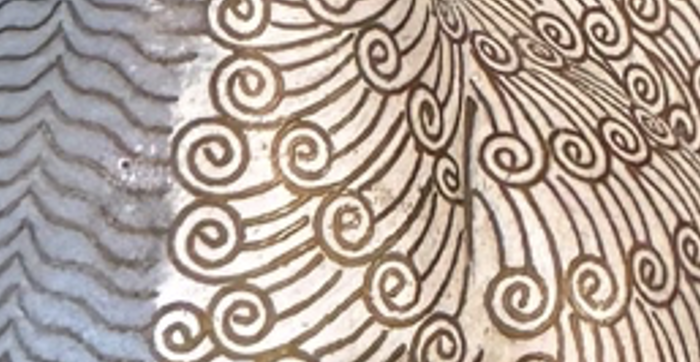
The diaper pattern on Recumbent Ram (#1, CC Library Case #1, left side).
Diapering is a surface decoration composed of connecting repeat geometric shapes such as diamonds, squares, curls, cloud forms, etc. In this case, the pattern mimics the curly fleece of a ram. Many of the objects in this collection use a cloud-shaped pattern, which references celestial and divine space.
C.C. Library, Case #1-Left Side
1. Recumbent Rams (Pair), China, Qing Dynasty, 18th-19th Century
Two white-ground rams with diapered fleece, recumbent, each with a front leg bent, head raised, mouth agape, and hind legs tucked beneath the body. The horns, hooves, and beard are gilded. With removable lids, the rams are likely incense burners.
CC-87 A/B
2. Lidded Jar, China (c. 1900-1930)
A blue and black lidded jar featuring a light-blue dragon design.
CC # 60
3. Bull's Head Rhyton, China, c. 1900-1930
A turquoise-ground libation cup, or "rhyton," in the form of an ox-head with golden ears and horns, and archaistic motifs.
CC-28
4. Tea Pot, China, c. 1900-1930
A polychrome enamel cloisonné teapot with a blue dragon motif, a yellow handle, and a yellow spout.
CC-30
5. Lion Vessel w. Carved Wooden Stand, China, c. Qing Dynasty, 1644-1912
The standing lion boasts red, blue, and gold archaic designs on a turquoise ground. A covered vessel that fits into the lion's back is decorated in a similar manner, with the addition of yellow dragons.
Known as a “Foo Lion,” such figures were generally part of a male-female guardian pair. The closed-mouth female is believed to keep good spirits in the home, while an open-mouth male is thought to scare evil spirits away.
CC 27
6. Teapot, China, c. Qing Dynasty, 1644-1912
Decorated with polychrome enamel foliate designs, this whimsical teapot has a gourd-like form and a lid decorated with a gourd-shaped golden knob.
CC-31
7. Plate,
CC-?
C.C. Library, Case #1-Right Side
9a. Horse, China, c. 1900-1930
Standing on a carved wooden base, this red ochre horse-form censer (incense burner) has a diapered ground and gold highlights. The blue foliate saddle can be removed to cover the vessel's opening.
CC 86 B
9b. Horse, China, c. 1900-1930
While horses 9a and 9b have mirrored poses and were previously classified as a pair, they are likely drawn from different pairs. In comparison to the dark red-brown coloring of 9a, Horse 9b has a turquoise ground with archaic scrolling designs and gold highlights.
CC-86 A
10. Incense Bowl, China, unknown date
Standing on a carved wooden pedestal, the bowl has a blue interior decorated with peonies, which symbolize wealth, honor, and good fortune on a diapered white ground. Also known as censers, incense dishes have been used in China for centuries to scent rooms, clothing, and as part of religious ceremonies.
CC 5
11 a & b. Quail Censors (Pair), China, Late 18th century
A pair of quail form incense burners on circular, floriate, blue ground bases. The birds' removable wing sections reveal their hollow bodies. A fighting bird, the quail is an emblem of pugnacity and courage.
CC-20 A/B
12. Small Covered Jar, Japan, Meiji period (1868-1912)
Polychrome flowers and vines scroll against the dark blue, green, and turquoise ground of this small jar.
CC-61
13. Lidded Jar
CC-34
14. Round Lidded Box
CC-37
C.C. Library, Case #2-Left Side
1. Seated War God, Nepal, date unknown
A male warrior with bronze crown, seated on a polychrome cloisonné base. The figure’s head, hands, and warrior attributes are bronze.
CC-29
2. Three Dragon Teacups, China, Qing Dynasty, 1644-1912
Red, blue, and green cups sport a gold trim and a five-clawed dragon design, which was traditionally reserved for the imperial family. As these cups boast an imperial design and handles, which were rare on Chinese cups, they were likely made for export to the European market in the late 18th or early 19th centuries.
CC-77 A/B/C
3. Tea Set, Japan, Edo Period c. 1603-1868
A yellow-ground teapot, lidded jar, and creamer with turquoise interiors and stylized flower and foliage motifs set against a geometric diaper pattern. Not a traditional part of Chinese tea consumption, the creamer indicates the set was made for export to the milk-loving European market.
CC-65, CC-67, CC-64
4. Crane, China, Qing Dynasty c. 1850
A naturalistic white crane with a red crest stands on a cloisonné base decorated with flowers and scrolls. The bird's feathered details are rendered in white, black, green, blue, and yellow enamels.
Because they generally have a long life, cranes were traditionally associated with longevity, immortality, and wisdom in China, particularly following the late 2nd century CE rise of Daoism. A Daoist priest was said to be able to transform into a crane.
CC-85
5. Scallop-Edged Plate, Japan, Meiji/Taishō Period, c.1868-1912
The plate's central medallion displays a cluster of pin peonies, daisies and leaves. It is surrounded by concentric geometric, floral, and insect designs. The underside is blue with scale-like diapering. Highlighted in gold, the scalloped edge suggests a Moorish influence.
CC-6
C.C. Library, Case #2-Right Side
6. Vase, Japan, Meiji Period, c. 1868-1912
Peonies in full bloom and cherry blossoms in shades of pink, white, and green appear to bloom across a lustrous black ground.
CC-59
7. Lidded Box, China, Qing Dynasty, 18–19th Century
Supported on four spherical feet, the yellow-ground box has a blue border framing the hinged lid, and pink, blue, and turquoise chrysanthemums throughout.
Indigenous to China, the Chrysanthemum is used in Chinese medicine and symbolizes longevity, vitality and, because it blooms in the fall, a determined spirit.
CC-68
8. Incense Burner, China, Chien Lung Period, c. 1736-1796
Multi-colored flowers adorn the turquoise ground of a nearly spherical container. The container is supported by filigree arms that spread from an inlaid stem. The object is missing its pierced metal cover.
The censer may have been part of a five-piece altar set or wugong (the five offerings), or it might have functioned as a hat stand. If so, fragrant spices or incense would be placed inside the sphere to perfume the headdress.
CC-2
9. Vase, Japan, Meiji Period c. 1868-1912
The brown ground of this baluster-form vase is adorned with a phoenix, emblematic of rebirth and immortality; floral motifs; and butterflies that represent transformation and rebirth. The vase has a turquoise interior.
CC-12
10. Baluster Vase, Japan, Meiji Period, c. 1868-1912
An example of the bokashi technique, in which the color subtly graduates from one shade to another, the ground of this vase transitions from pink/beige at the neck to grey/green at the base.
Small, stylized flowers and foliage adorn the rim and base of the vase, while illusionistic white and pink chrysanthemums frame a view looking towards a distant building. The muted tones and polished surface are the result of using matte enamels and careful grinding.
CC-15
C.C. Library, Case #3-Left Side
1. Toad/Frog-Form Incense Holders, China, c. 1850-1930
Two kneeling four-legged frogs (or toads), their mouths open to hold an incense stick. The frog symbolizes fertility in China because the word has the same pronunciation as the word for baby; while, in some Chinese dialects, "toad" (chán) sounds similar to "coin" (qián).
CC-22 A/B
2. Trinket Box, Japan, c. 1900-1930
A blue heart-shaped box with a chrysanthemum decorating the lid. In Japanese culture, the chrysanthemum is associated with the imperial family, longevity, and rejuvenation.
CC-48
3. Rectangular Box, Japan, early 20th century
The dark blue ground of the box is decorated on the sides with white flowers and, on the lid, with flowering branches and a parrot-like bird.
CC-5
4. Small Box, Japan, c. 1900-1930
A circular blue pillbox with a chrysanthemum adorning the lid.
CC-48
5. Boy with Hobby Horse and Dog (Pair), China, early Eighteenth century
Two identical smiling boys stand astride hobby horses on footed, turquoise-colored pedestals. Their clothing is decorated with auspicious dragon motifs, and a small dog stands beside each child.
Children at play, particularly small boys engaged in auspicious activities, have been a popular theme in Chinese art since the Song period (960 1279). They symbolize a wish for many male offspring. With the term 'on top of a horse' (mashang) meaning 'immediately,' these figures express desire for the imminent birth of a son.
CC-26 A/B
6. Napkin Ring, China, c. 1900
A red-ground napkin ring with cloud-diaper pattern, gold trim, and a blue interior. As napkin rings originated in France around 1800 CE, this was likely made after the Opium Wars to meet the Western demand for Chinoiserie.
CC-39
7. Blue Plate, China, c. 1900-1930
A blue-ground plate with a central floral motif and geometric borders in black and white cloisonné.
CC #?
C.C. Library, Case #3-Right Side
1. CC-47A & B?
2. Pair of Vases, Japan, c. 1900-1930
Decorated with flowers and foliage below the rim and above the base, these vases are examples of the bokashi technique, in which a color subtly graduates from one shade to another.
CC-32 A/B
3. Water Buffalo with Herder (Pair), China, late 18th century
Herders holding onto fine brass reins sit astride the recumbent animals, which are decorated with dragons and scrolling vines.
Underpinning Chinese agricultural production, the buffalo symbolizes a simple, bucolic life, springtime, endurance, and tranquility. Additionally, both Buddhism and Daoism align ox herding with the process of attaining spiritual enlightenment.
CC-21 A/B
4. Spectacles and Case, China, Qing Dynasty, 18th/19th Century
A pair of yellow-lensed eyeglasses are held inside a yellow-ground cloisonné case in two sections. The lower section is decorated with images of a warrior, a saddled horse, and an elephant. The upper section is decorated with a lotus flower. The sections are strung on a silk cord that terminates with a porcelain bead and a silk tassel.
Cloud diapering throughout the case indicates a celestial association. The combined symbolism emphasizes themes of divine intervention, strength, and protection, perhaps in a time of travel or conflict.
CC 43
11. Pipe, China, c. 1900-1930
A deep blue pipe with geometric floral designs and a strap.
CC-?
12. Pedestal Bowl, China, c.1900-1930
The black bowl boasts intricate floral designs, interior geometric border and gold-lined rim.
CC-?